

By Joseph Reichert
- © 2025 Joseph Reichert, Inc.
- First Publication: May 6, 2025
- Revisions: January 17, 2026; June 15, 2026; August 19, 2026
NOTICE OF COPYRIGHT AND LIMITED LICENSE TO REPRODUCE AND DISTRIBUTE THIS DOCUMENT
Joseph Reichert, Inc., a New Mexico corporation, owns the copyright in this document, and is the only person lawfully allowed to publish it. Joseph Reichert, Inc., makes a special exception to its exclusive rights in this work, and all persons are hereby granted a license to reproduce and distribute it, subject to the following conditions: (1) Under no circumstances shall any charge be exacted for any copy of this document, including charges for the costs of reproduction or distribution of the same; (2) any and all copies distributed pursuant to the terms of this limited license must be given in complete and unmodified form, including the full text of this Notice, which must be conspicuously displayed on the first page. Any use of this document which varies from the terms of this license is a violation of the copyright owned by Joseph Reichert, Inc., and infringement will be vigorously pursued under the terms of the United States Copyright Act.
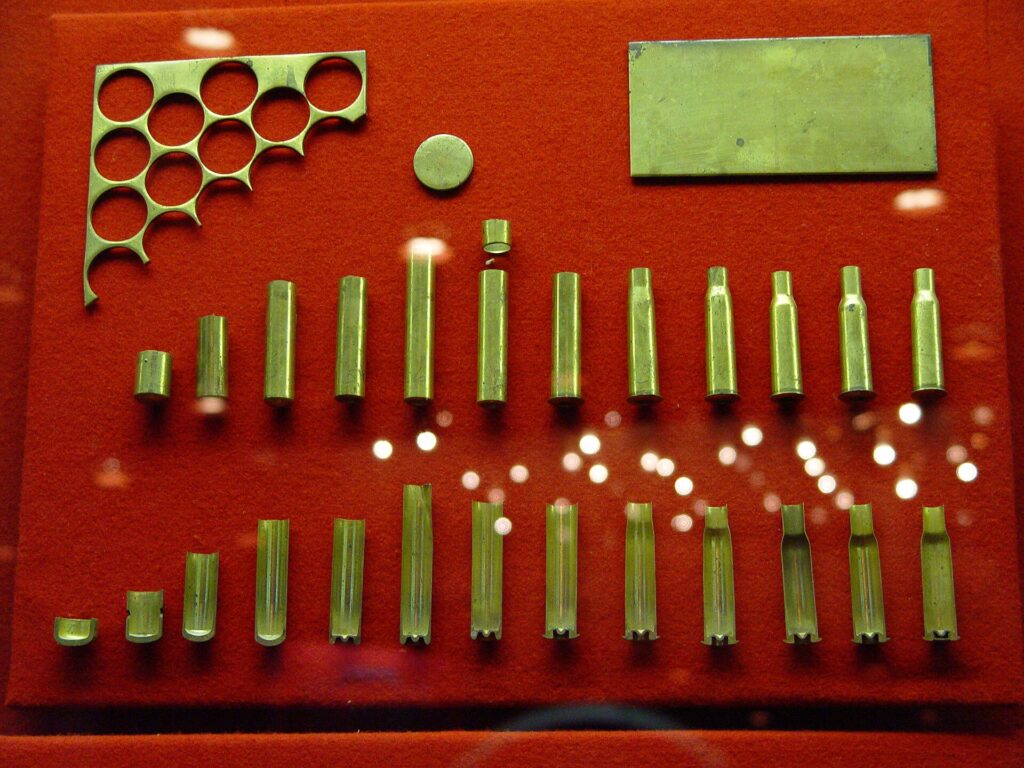
Making cartridges by progressive extrusion operations. Is this the only practical method?
INTRODUCTION
Making cartridges by brass extrusion. Or might it better be called “the secret art” ?
Anyone familiar with the instructional materials on ammunition manufacture knows that it is difficult to locate usable information on making cartridges. This is not to say that it is nonexistent, but it is certainly scarce. Almost all of the literature I have been able to locate dates to the early years of the 20th century. It focuses on the promotion of wartime production. Clearly, this literature was created for companies catering to the United States Army and its needs during World War I. After that time, the majority of the books and articles relevant to this subject teach general principles of brass extrusion, but very little specific to making cartridges.
THE FOCUS OF THIS ARTICLE
This situation is rather curious, because books covering the building of firearms delve into challenging aspects of metalworking. We need only consider recent treatises on rifling machines and the construction of receivers to notice that anybody using the techniques described in them will need solid instruction, and a reasonable amount of experience, in the use of machine tools. Are the prerequisites for making quality rifle barrels less demanding than constructing the tooling for brass extrusion?
The purpose of this short article is to pose that question, and to suggest that making cartridges may be carried out by procedures other than extrusion.
Making Cartridges: Why So Little Instruction On This Process?
Several possibilities explain the dearth of instruction on cartridge making. Foremost among these is the wide availability of commercial ammunition. Tools and materials for reloading cartridges are prevalent. The firearms community lacks interest in producing articles so common and easy to acquire.
Another explanation which comes to mind is the tedious nature of making extrusion tools. In the matter of ammunition, fabricators must always produce precise results. Extrusion tooling is not a matter of deep insight or gifted genius, but it requires tenacious attention to detail and patience. I learned this when I had to manufacture press tools to extrude tantalum cups. The job required that these cups be of exactly prescribed height, diameter, and wall thickness. Eventually, I got it right, but only after a number of failures when the metal refused to behave as I predicted it would.
Making Cartridges By Extrusion, Guns By Stamping
Making cartridges by extrusion has much in common with the manufacture of firearms by metal stamping. Both extrusion and stamping are metal forming techniques, and the principles of economy of scale apply to both operations. To understand the feasibility of such operations from the standpoint of capital investment, it is profitable to view an installment on Ian McCollum’s Forgotten Weapons channel. In his lecture, he explains why manufacturers are reluctant to make stamped metal guns, unless large sales are guaranteed.
To extrude metal for any purpose requires a press of high tonnage. To be practical, making cartridges requires a fast acting machine with convenient operator controls. I tried tantalum extrusion without such a press. The fact that I did the press work with a hand pumped hydraulic cylinder was the most annoying part of it. Had I owned a fast acting automatic press, it would have been an easier experience. Of course, small shops which possess only basic tools seldom have high capacity presses. One can understand the reluctance of hobbyists and even small scale commercial operations to pay for such a machine.
Alternatives To Extrusion For Making Cartridges
We should note that extrusion is not the only method we can use for making cartridges. Several sources report that Harry Pope, the great barrel maker, produced straight walled cartridges by machining them on a lathe. He made these in small batches, about a dozen at a time, and he reloaded them many times over with black powder. They served him well in rifle competitions, where he won great renown as a marksman. This is a possible solution to manufacturing cartridge cases, at least if our goal is to make the straight walled variety. However, it also demands that we generate large volumes of chips. At the present cost of brass alloy, this does is not an optimum solution.
I am confident that we can adapt the brass extrusion process and make it functional for a small shop. However, my confidence is not so great that I think our work on this process will be easy. I have thought up a few ideas for simplifying cartridge extrusion, but at this time I have nothing that goes beyond conjecture.
To simplify making cartridges, we may be able to use a technique of partial machining. By this, I mean nothing more than elaborate preparation of the blank for our extruded part.
Fabricators might hollow out a brass slug by drilling, then subject the partially hollowed blank to extrusion in a press. The void created by the drilling operation must closely approximate the interior of the finished cartridge. This means they will have to displace less material, and perhaps use lower tonnage than required by a solid blank. However, the drilling operation still wastes brass as chips.
Two Books Which Address Making Cartridges
Returning to the question of instructional literature on making cartridges, two books stand out as promising sources of actionable information. The first of these is Cartridge Manufacture by Douglas Hamilton (New York, Industrial Press, 1916). The author addressed it to America’s manufacturing companies. Clearly, the prospect that the U.S. would soon intervene in World War I inspired this book. It is useful because it describes the process of brass extrusion in great technical detail.
Another more recent book is also valuable, Ammunition Making, authored by chemical engineer George Frost, (Washington D.C., National Rifle Association Publications, 1990). Mr. Frost was a professional consultant to ammunition manufacturing concerns, and his work also explains making cartridges in some detail.
CONCLUSION
If we want to pursue making cartridges, extrusion is presently the most efficient process. It is probably the most economical method, at least if we are making cartridges on a very large scale. But is it the only workable method? Can we carry out small scale production with relative efficiency by other techniques?
The only way we can identify alternative methods of making cartridges is to conduct experiments directed at that goal. In this enterprise, we may benefit from reviewing past experiments in cartridge making. When we conduct such reviews, I suggest that we ought to identify how these experiments failed, and focus on possible modifications which promise to improve their results.