
By Joseph Reichert
- ©2026 Joseph Reichert, Inc.
- First Publication: July 18, 2025
- Revisions: January 26, 2026; June 14, 2026; July 23, 2026
NOTICE OF COPYRIGHT AND LIMITED LICENSE TO REPRODUCE AND DISTRIBUTE THIS ARTICLE
Joseph Reichert, Inc., a New Mexico corporation, owns the copyright in this document, and is the only person lawfully allowed to publish it. Joseph Reichert, Inc., makes a special exception to its exclusive rights in this work, and all persons are hereby granted a license to reproduce and distribute it, subject to the following conditions: (1) Under no circumstances shall any charge be exacted for any copy of this document, including charges for the costs of reproduction or distribution of the same; (2) any and all copies distributed pursuant to the terms of this limited license must be given in complete and unmodified form, including the full text of this Notice, which must be conspicuously displayed on the first page. Any use of this document which varies from the terms of this license is a violation of the copyright owned by Joseph Reichert, Inc., and infringement will be vigorously pursued under the terms of the United States Copyright Act.
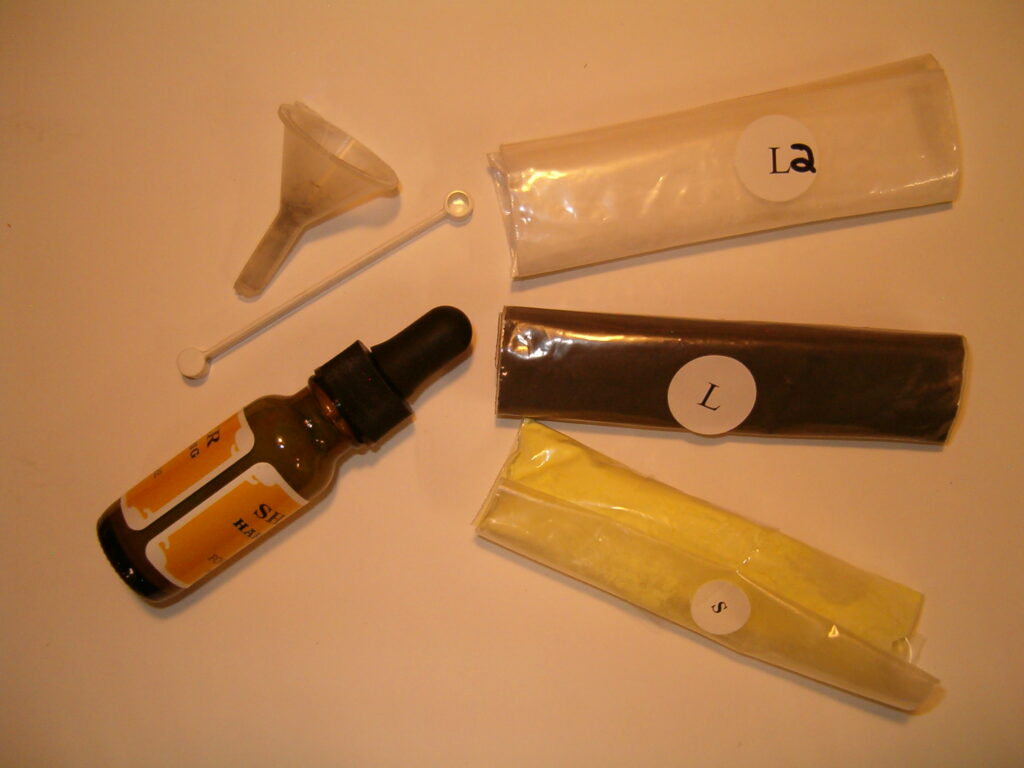
The six components included in the Prime All kit: funnel, measuring scoop, liquid binder, and three chemical mixtures.
INTRODUCTION
It is clear that interest in reloading spent primers has grown in recent years. Several factors cause this phenomenon, but the core cause is fear that ammunition will disappear. Hunters and sport shooters are aware that reloading, in the conventional sense, is not a solution to the problem of ammunition scarcity.
Reloading is an ideal way of creating the loads we would like to have. We can adjust them to the idiosyncrasies of our individual weapons. By reloading, we can match our ammunition to the particular type of shooting we pursue. Reloading provides options to the marksman. It frees him from dependence on a narrow range of factory manufactured ammunition.
But if there is no ammunition at all, it is unlikely that reloading will bring an adequate supply back. Consider the entire manufacturing process from start to finish. If powder, brass, primers and bullets are available for sale to the public, then factory assembled ammunition should also be on offer. If the factory made product has disappeared, its individual components have also vanished.
THE FOCUS OF THIS ARTICLE
It is my opinion that a large segment of shooters now view the matter in this way. They want greater control over their supply of ammunition components. Merchandisers recognize this concern, and would turn shooters’ desire for a steady supply of ammunition into a business.
This article focuses on one response to the issue of primer scarcity. Certain suppliers now offer the basic materials to recharge primers. I will recount my own experience with a primer making kit, sold under the name of “Prime All”. With this experience as a reference, I discuss its benefits, its defects, its hazards, and its improvement.
My ultimate judgment on this product is that it is good, but could be better. In a few aspects I think it could become dangerous to its users. With regard to these safety issues, I would counsel the sellers of Prime All to make it better fast.
I PURCHASE THE PRIME ALL KIT
Imagining What Will Arrive
Out of curiosity, I recently ordered a primer reloading kit sold under the name of “Prime All”.
Before my order arrived, I spent a little time imaging what I would receive. I have done some reading on the subject of primer manufacture, and think I have seen the recipes for most common primer mixtures.
Since the advent of percussion priming, the manufacturers of primers have not come up with many suitable compositions. Many contain energetic materials that most carriers refuse to handle. Based on this knowledge, I conjectured that the material supplied would fall into a rather narrow category of priming compounds.
What I Received
When my order arrived, I found the package to contain a selection of items that appeared to correspond to my expectations. It held a small plastic bag of white powder, a small bag of yellow powder, and a third bag of black powder. It included a single plastic scoop with a miniature measuring cup on each end, a dropper bottle filled with turquoise colored liquid, and a miniature funnel made of clear plastic.
I found an instruction sheet in the kit. The instructions covered the recharging of Boxer type primers. In other words, the user starts with fired primers of the type that contain separable anvils. These anvils often take the shape of small shamrocks.
As described in the instructions, the combination of the four supplied ingredients results in an impact sensitive igniter mixture. If properly compounded, it will generate enough heat to ignite any common propellant, be it black or smokeless powder.
I TRIED PRIME ALL
Preparing The Spent Primers
Before recharging spent primers, it is first necessary to separate the anvils from the cups. Next, one must straighten out the cups by flattening the dimple left in them by the firing pin.
All these components should be scrupulously clean before starting the process. . In this way, I prepared twenty primers for recharging.
Reloading The Primers
I want to do justice to this product, and carefully followed the instructions supplied. Using the measuring tool provided, I placed two large scoops of the white powder, one large scoop of the yellow powder, and one small scoop of the black colored powder in a small plastic mixing cup. Following the supplied instructions I mixed them thoroughly with a little wooden paddle. I used the sort of paddle often used with paint pigments, working out all lumps until the mixture became an even gray color.
As per instructions, I proceeded to charge a dozen of my prepared large rifle primers with this mixture. As instructed, I reassembled the primer cup and anvil, finishing each primer off with a drop of the mysterious turquoise liquid.
I Make Functional Primers
I left the primers to dry for several days before assembling them in cartridges, installing them as I would any other new, commercially manufactured primers. To sum it up in simple words, they worked. In fact, the finished ammunition functioned quite well from the standpoint of accuracy. I think much of this is due to the fact that I used new, very high end brass and high quality Hornady bullets to create middling velocity .30-06 rounds. The primers did what they should do, reliably igniting the powder.
From this experience, I must conclude that this product is sound. It is good, but could be better.
Primer Formulas Explained
To outline my proposed improvements, I must provide additional information on primer technology.
I have been experimenting with pyrotechnics, black powder, and impact sensitive explosives for many years. I believe I have uncovered every priming composition ever used in the manufacture of small arms ammunition, and know many of the recipes.
Two Basic Classes Of Primer Compositions
Priming compositions fall into two basic classes. Those now in common use contain sensitive high explosives such as tetracene, TNT, and lead styphnate. None of the materials contained in my kit bear any resemblance to these hazardous substances. A second class of priming mixtures consists of those which contain some quantity of potassium chlorate. This compound yields an impact and friction sensitive product when we mix it with sulfur, or sulfur bearing compounds.
As noted, most modern primer mixtures exclude chlorates, deriving all their energy from high explosives and other ingredients. The sellers often label these as “noncorrosive.” It is also possible to achieve completely reliable ignition using only potassium chlorate and a suitable fuel. The fuel is almost always sulfur or a sulfide. Many shooters censoriously call these “corrosive primers.”
The Most Corrosive Composition
I do not believe that any primer composition can be absolutely “noncorrosive.” This is also true of our modern propellent powders. The important point to bear in mind is that any primer containing any quantity of chlorate will initiate vigorous corrosion, which commences soon after firing. It will be even more aggressive if humidity is high. You must always clean your firearms. However, if you use chlorate based primers, you must clean as soon as you finish shooting. Use a solvent suitable for black powder. Personally, I still believe in soap and water for this task.
What I Really Bought
The priming mixture produced with my Prime All kit is indisputably a chlorate based, impact sensitive explosive. We can infer this from the fact that the ingredients include nothing that looks, smells or reacts like a high explosive. We also know that Prime All can ship its product in interstate commerce. This is itself evidence that it contains no tetracene, TNT, or similar high explosive material.
When we use this kit, we are manufacturing ordinary corrosive primers of the old style. The United States military used such primers through 1946, or thereabouts. In the literature on the subject, we can find a number of chlorate based formulas. For much of the twentieth century, ammunition manufacturers used these formulas in their products.
There is nothing inherently wrong with chlorate based priming compositions. When I say that Prime All is good, but could be better, I do not fault its basic chemistry.
A Classic Recipe
Dr. Tenney L. Davis, in The Chemistry Of Powder And Explosives, (John Wiley And Sons, Inc., New York, 1943) states the following formula:
- Potassium Chlorate: 50.54 %
- Antimony Sulfide: 26.31 %
- Sulfur: 8.76 %
- Ground Glass: 12.39 %
- Shellac: 2.00 %
(All measurements by weight)
The exact role of the ground glass in this recipe is not clear to me. I have always believed that manufacturers add glass to sensitize the composition. It provides an extra element of friction to the impact of the firing pin. Some authorities specify the use of borosilicate glass. They caution against the use of other varieties. In my own work in this field, I have never added any type of glass to a primer. I have had success despite this omission.
Why Glass?
I conjecture that powdered glass makes primers more sensitive. Even when we do not completely integrate the ingredients in the priming mixture, glass will perhaps sensitize a less than perfect job of integration. This is only a guess on my part. In favor of glass, let me say that I cannot believe it will do any harm. If you want genuine borosilicate glass, many sellers offer it online. In its powdered form, it is very cheap.
Binding The Mixture
Davis includes shellac in his formula as a binder. The other ingredients require a “glue” to hold them together. Manufacturers dry mix shellac with the other powdered ingredients. They activate its properties as a binder by placing a small drop of alcohol in each primer. Once the alcohol has dried, the plasticized shellac hardens and encases the other ingredients. The components congeal into a solid pellet. This hardened mass will not break easily.
To include a binder such as shellac is only common sense. The primer composition must stay in one piece, between the base of the primer cup and the anvil, if the primer is to remain functional.
Another Traditional Recipe
Ammunition expert George E. Frost mentions a very similar formula his book Ammunition Making (Washington, D.C., National Rifle Association Of America, 1990). On page 48, Frost notes that many years ago, the Army found the shelf life of fulminate primers unacceptable, and changed to a formula made up of sulfur, potassium chlorate, and antimony sulfide. He does not specify the proportions of these ingredients, but the basic formula is the same as that provided by Davis.
Chlorate And Sulfur Mixtures Are Perilous
I have thus far neglected to mention the potential dangers of mixtures containing both chlorates and sulfur. Anyone who has received formal instruction in the craft of pyrotechnics will know the dangers we create when we mix these two substances. Their combination is notorious in the pyrotechnic trade because it can produce spontaneous combustion in fireworks. Many writers hold that atmospheric air causes sulfur to degrade into sulfuric acid. This acid produces combustion upon extended contact with chlorates. Such a mixture is uniquely unpredictable and dangerous.
Chlorate And Sulfur Mixtures Made Less Perilous, And More Reliable
Interestingly, Davis notes that the “souring” of chlorate/sulfur mixtures can cause primers to become insensitive to impact. Without adjustment, a chlorate and sulfur mixture has two serious defects. It may spontaneously combust, and it may become insensitive to the impact of a firing pin.
A solution to the “souring” problem, as adopted by the pyrotechnic trade, is to substitute potassium perchlorate for potassium chlorate in fireworks. However, I have no personal knowledge concerning the impact sensitivity of potassium perchlorate mixtures. In pyrotechnics, manufacturers want the brilliant colors produced by perchlorates and chlorates. They are equal in their power to produce strong visual effects. However, without additional controlled experiments, I would not count upon potassium perchlorate to be effective in primers.
IDENTITY OF THE PRIME ALL INGREDIENTS
Can we identify the unnamed ingredients contained in the Prime All recharging kit?
The kit delivered to me bears no notice of a patent claim. The seller’s coyness about revealing to me what I purchased convinces me that the ingredients supplied are common and inexpensive. The enterprising vendor wants to maintain the identity of these materials as a secret. However, those who have a basic knowledge of pyrotechnics and are willing to practice a little “reverse engineering” can puzzle it out.
Potassium Chlorate And Sulfur
I am confident that the white powder supplied with this kit is potassium chlorate. It is the obvious choice for a primer compound which lacks the high explosive components previously mentioned. I frankly admit that I have not placed these materials in the hands of an analytical chemist. However, I do not think that I must go to this expense to know what I have.
The bag of yellow powder is likewise no mystery. Upon opening it I immediately detected the smell of sulfur. If Prime All has given me a good product, this is the high quality version known as “rubber maker’s sulfur”. This is the acid-free variety used in the tire industry to vulcanize rubber.
The Mysterious Black Powder
The black colored powder is a greater mystery. I first thought that it must finely pulverized antimony sulfide. However, there are several problems with this conclusion. I compared the black substance from my kit with a high grade sample of antimony sulfide. I detected a slight difference in appearance. The material in my kit has a shiny quality to it, reminiscent of the reflective surface of clean anthracite. By contrast, my sample of antimony sulfide has a grayish color. In my judgment the sulfide is slightly duller, though not by much.
Not Antimony Sulfide, Not Charcoal
The most decisive difference between the black mystery powder and antimony sulfide is their difference in flammability. I placed a sample of finely powdered antimony sulfide on a piece of white index card and set the edge of the card alight. When the fire reached the antimony sulfide, nothing happened. The card burned away around the sample, and dumped the antimony sulfide on the fire brick base where I perform such tests.
Some of my correspondents have proposed that the black powder is charcoal. Allowing that this could be true, I repeated the “index card test”. A small pile of pyrotechnic charcoal smoldered slowly, like an incense stick.
When I put the unidentified powder to the test, the sample burned vigorously. It burned in a way similar to a sparkler, emitting a flash of crackling sparks. These little meteors exploded at the apogee of their travel. The whole mass of my sample burned up very quickly. It bore no resemblance to antimony sulfide, nor to charcoal.
It Behaves Like Titanium Powder
If I wanted to create this visual effect in a pyrotechnic display, there is one material I would choose: titanium. 325 mesh titanium creates the sparking phenomenon generated by the mystery powder. Pyrotechnic supply companies sell it for that exact purpose. The addition of it to a primer mixture is squarely in the noble tradition of historical primer compounds.
Many treatises that cover priming compounds advocate the addition of pulverized metals to these mixtures to generate sparks. The metal enhances a primer’s ability to communicate heat to powder. Some writers advocate the addition of aluminum, others prescribe heavier metals and lead compounds. I think titanium to be a good choice for this role, because it burns at a very high temperature. 325 mesh titanium makes durable sparks. Titanium leaves long trails when incorporated into display fireworks. Books on military pyrotechnics advocate the use of titanium powder for kindling fuses. It will generate the high heat required to set off certain detonators.
The Power Of A Titanium/Sulfur Mixture
This primer mixture contains elemental sulfur. I also note that sulfur mixed with a metal powder is, without more, a recognized propellant. These mixtures can usually sustain burning inside a closed vessel, in the absence of oxygen. Potassium chlorate accelerates this process. It is the chlorate which renders our primers impact sensitive. It also ensures that the three-part mixture burns with an intense flash.
Probably Titanium
I wanted to move my conclusions from the realm of conjecture to the category of fact. To test my conjecture, I combined a substantial quantity of sulfur with a like volume of this black mystery powder. After mixing these ingredients well, I set fire to the mix and observed it to burn quickly, like a slow burning gunpowder, and in a way very similar to a 50/50 mixture of sulfur and zinc.
This latter formula was once a favorite of amateur rocket experimenters. It gives a consistent but low powered impulse to small rocket engines. The experiment confirmed in my mind that the mysterious black powder is indeed an elemental metal. Given the sparks it produced, I conclude that it is titanium.
Titanium powder is readily available from pyrotechnic suppliers. Suppliers of materials used in 3D printers also sell it. These dealers offer it in 325 mesh size, at affordable prices. It can perform the function of a heat transfer agent in our primer composition.
The Blue Liquid Is A Binder
The last ingredient remaining to be identified is the “mysterious blue distillate”. This is really less problematic than the other components. It is a binder of some sort. The list of primer formulas is replete with all sorts of binders. All of them I have tried keep the primer pellet intact. The fact that it is blue is very sensible. First, it makes it look mysterious, another piece of the impenetrable magic of our kit. Second, and more practically, the color lets us know if we have remembered to add it to our primers. The violently cerulean color shows up in the primer cup after it dries.
Several Good Choices For A Binder
I did not attempt to determine exactly what goes into this liquid hardener. I will instead refer to the wide range of choices drawn from many primer formulas. But first, let me note that the blue liquid provided with the kit is probably a water-based compound. It lacks the odor of alcohol, toluene, or any of the other aromatic solvents often found in primer hardeners. But even if we confine ourselves to only water based hardeners, we can still choose from an enormous range of satisfactory alternatives.
A Traditional Binder Formula
Davis, in The Chemistry Of Powder And Explosives, (p. 455,) mentions several binders for primer compositions. Among them he lists water with gum arabic, and water with gum tragacanth. Frost, in Ammunition Making (p. 58) gives an exact formula for a large batch of water-based composition:
- Gum Tragacanth, 100 grams
- Gum Arabic, 50 grams
- Gelatin, 10 grams
- Thymol, 1.5 grams
- Water, 1.9 liters
The operator must heat the water to 75 degrees C, and then add the gum tragacanth, gum Arabic and gelatin to it. The temperature must remain constant for three hours. Next, he must leave the mixture to cool. When the batch drops to room temperature, the he dissolves the thymol in 15 mL of alcohol and adds it to the cooked solution. The thymol serves as a preservative. Frost notes that, even with this addition, the solution only lasts about two weeks in refrigeration.
The Simplest Binder
If we intend to use a water based binder, it is my opinion that a freshly mixed batch of 5% gum Arabic solution will give a satisfactory result. This is the binder we typically see in match heads, the friction primers on flares, and for binding an illuminating mixture to sparkler wires.
If we want a better and more waterproof binder, pyrotechnic literature shows us many binder solutions based on alcohol soluble plastics. We can use these to solidify all sorts of powders. I believe that an experimenter could make very durable primers with these. However, their use cannot be briefly described. This topic requires an entire article unto itself.
No matter the binder formula we choose, we are at liberty to tint it any color we wish.
Does It Have Other Ingredients?
Prime All may contain additional materials, beyond those I have already identified. The addition of small traces of certain other ingredients could be advantageous. They might enhance the safety and reliability of primers produced with it.
An Antacid Would Make Sense
I have already established that potassium chlorate is probably present in this mixture, along with sulfur. It would be highly desirable to add an antacid to the mixture, to prevent the “souring” of sulfur in the presence of chlorate.
A simple and effective antacid for chlorate/sulfur mixtures is sodium bicarbonate, something, cheap, safe to handle and effective. Sodium bicarbonate is one of the additives the fireworks industry uses to lessen the danger of chlorate/sulfur recipes. But be cautioned: the effectiveness of any antacid depends upon how thoroughly it is incorporated into the mixture. Later, I shall explain why I think mechanical incorporation of priming ingredients to be superior to manual combination.
It is also possible that the white powder included in the kit contains potassium perchlorate, rather than potassium chlorate. In that case an antacid would not be required.
A Dry Binder May Also Be Present
It also seems possible that one or more of the three powders provided in this kit have a certain amount of binder material mixed into them. The instructions provided with my kit contain the remark that the blue liquid serves as an activator for binding the mixture, meaning that the binder could be present within the other three ingredients. I believe the turquoise liquid is a water-based solution. The binder used in Prime All could be something as simple as a small quantity of gum arabic mixed with the main powdered ingredients.
PRIME ALL CRITICIZED
I have now provided necessary background, and can get to the gist of this article. As I stated in the title, Prime All is good, but could be better. Here is a list of the faults I find, together with improvements I propose.
Defect: Mixing By Volume Is An Inconsistent Process
A recipe is meaningless if it does not specify the quantity of each required ingredient. As noted at the beginning of this article, the Prime All kit I purchased includes a double ended measuring scoop. The instructions specify the proportions of each ingredient by quantity, and not by weight. This provision is adequate, because the mixture produced functions effectively. But it would be far better for us to mix by weight and not by volume.
I used an RCBS balance-type powder measure to weigh the prescribed volumes of the components supplied. I obtained the following results:
- Potassium chlorate, 3.0 grains
- Sulfur, 1.5 grains
- Titanium, 3.0 grains
Therefore, by mass, the Prime All compound consists of 40% potassium chlorate, 20% sulfur, and 40% titanium powder, not taking into accountant any weight attributable to traces of other additives, such as a binder and an antacid.
Improvement: We Should Mix Prime All By Weight
Prime All is good but could be better. Here is a suggestion to make it better.
I weighed out a number of samples of these materials, using the scoop provided. The masses stated in the foregoing formula are the averages around which the samples clustered. I noted a variation in the masses weighed out. I observed that this variation is connected to how tightly I packed the scoop when I ran it through the powdered ingredients. When we measure by volume, especially with a small scoop, we run the risk of leaving air pockets in the material measured. For consistency, we would do better measuring these ingredients with a precision balance.
In fairness, requiring the purchasers of Prime All to own a precision balance would inconvenience many customers. It would discourage some would be buyers from even trying it. It is therefore sensible economics for the seller to work out a formula where measurement by volume yields a mixture that is good enough. If it ignites the powder in our cartridges, it has done its job.
On the other hand, nobody familiar with commercial manufacturing practice would settle for this haphazard practice. It is less than optimal for consistency and reliability. At a minimum, a recipe based on weight should be provided. Those who wish to use volume measurement could still do so.
Prime All is good, but could be better. We should mix our ingredients by weight, not by volume.
Defect: Prime All Sells Us Unidentified Ingredients
Prime All is good, but could be better. I will now explain another needed improvement.
One must find fault with the vendor’s failure to identify the ingredients. They are effective for producing primers but potentially quite hazardous, even when not combined. Potassium chlorate is of particular concern. It is a material that will initiate burning, and will always accelerate a fire. If accidentally combined with carbonaceous material, including dried out foodstuffs, sawdust, or lubricants, friction can set it off. It will also ignite on contact with strong acids, including such things as the residue from car batteries.
If Prime All has given us potassium perchlorate instead of chlorate, we can dismiss a few of our concerns, but many would remain.
The titanium is also an issue of concern. I have used many powdered metals in the course of my employment, and in the enjoyment of my hobbies. All of them, even in small quantities, can spontaneously ignite if not well sealed in airtight containers. To leave them in proximity to a powerful oxidizing agent like a chlorate does not strike me as a sound practice. Mixing them is not per se hazardous, as this is what we will do in making primers. However, if they become moist under uncontrolled conditions, when not monitored, this might create a problem.
Prime All is good, but could be better.
Improvement: The Seller Should Identify The Ingredients
The vendor should label the chemicals sold in the Prime All kit by their proper scientific names. Each ingredient present ought to be accompanied by a Material Safety Data Sheet. This knowledge would permit the purchaser to investigate the properties of the ingredients, and take meaningful safety measures when storing and using them.
This is a matter of safety, and improvement is mandatory. I would counsel the sellers of Prime All to make it better fast.
Defect: Prime All Sells Us A Single Measuring Scoop
The provision of a single plastic measuring device invites the cross-contamination of the materials in the kit. The kit should contain a plastic measuring spoon for each chemical provided. It should also have a separate mixing paddle for combining all the ingredients.
The instructions should caution customers to carefully clean all utensils between uses. As the kit is now set up, each separate chemical could easily end up contaminated with quantities of the other two materials. All scientific and industrial laboratories scrupulously avoid this risk. It is both a quality issue and a matter of safety.
Prime All is good, but could be better.
Improvement: Prime All Should Provide A Separate Scoop For Each Component
The vendor of Prime All should not encourage bad habits in its customers. In the interest of safety and quality the seller should include at least four utensils in its kit, three sets of scoops and one mixing paddle.
It should instruct the user to use each scoop for only one component, and avoid cross-contamination of the basic ingredients. It ought to advise the customer to thoroughly wash the scoops and the mixing paddle after each use.
This is a matter of safety, and improvement is mandatory. I would counsel the sellers of Prime All to make it better fast.
Defect: We Need A Better Method Than Hand Mixing.
Another quality issue arises from the manual method of mixing the primer components. This may be controversial, but it is my opinion that the user should mix the ingredients mechanically. Quality requires a level of integration that is impossible to achieve by hand.
Prime All is good, but could be better.
After long experience mixing friction sensitive and impact sensitive pyrotechnic products, I am here to testify to one abiding truth: if you work with them over a long period of time, you will experience unintended ignition. Whether you are injured by this depends entirely upon where you decide to locate yourself when the event occurs. Do not remain close to any mechanical mixer you devise.
Mixtures of the type produced with the Prime All kit will inflict serious burn injuries. After all, primer mixtures must produce heat, and communicate that heat to other energetic materials. Agitating a priming mixture with a stick or spoon is to invite burns.
Improvement: A Mechanical Grinder
Chlorate based priming compounds can be easily mixed by placing them in a slowly rotating cup, made of wood. A and one and one half inch diameter lead ball may be placed in the cup as a crusher.. The cup should be open at the top, and slanted at about forty degrees from the vertical position. With this arrangement, the mixture and the crusher ball travel in the rounded section near the bottom of the vessel. You should always use such a mixing machine outdoors. Place a very lightly fitting wood or rubber cover on it to keep out debris.
To drive the mixer, a small low speed electric motor can be purchased for a modest price on Amazon or eBay. I have purchased several of these over the years for less than $25. The sellers offer many reliable specimens that turn at a rate of 15 to 25 rpm. Wooden cups of appropriate size can be located from the same sources. To mount the cup directly to the shaft of the motor, use a piece of plastic tubing epoxied to the base of the cup.
This arrangement will cause the flash from accidental ignition to travel upward and away from the motor. In my experience, such accidents will scorch the inside of the wooden bowl, and only burn its surface. The burned area can be easily sanded off and the little machine will be back in business.
How Long To Grind
In a setup of this type, you can conveniently turn the priming mixture for a period of 8 to 12 hours. When the mixing is completed it will prove to be absolutely uniform and very sensitive. Your only interaction with the priming mixture will be when loading your mixing machine, and when removing the completed priming compound. When you are close to the mixture, it is very important that you wear (at the very least) a polycarbonate face shield and leather gloves. More personal protective gear would not be a bad idea.
How Much Is Too Much?
In the case of a potassium chlorate/sulfur/titanium priming mixture, I would not hazard a guess about what amount constitutes a critical mass. My unjustified and factually unsupported hunch is that we are safe if we work with one gram or less at a time.
Remember that this priming mixture will go off unexpectedly if you fool around with it enough. This is my promise to you. What happens when it misbehaves will depend entirely upon where you are located when it chooses to do so. I
Keep the amounts small. The instructions provided with the Prime All kit provide for the preparation of about 7.5 grains of this substance, approximately half a gram. Even this small amount can inflict a very painful burn, and none of us want that.
Prime All is good, but could be better. However, when we improve it, let us be alert to any danger we introduce.
Defect: We Do Not Have A Method To Place An Exactly Equal Charge In All Primer Cups
The next problem I see with the Prime All kit is that it provides no method to charge all primers equally. By equal charging, I mean the same mass of composition in each cup. To have any hope of making a uniform product, we must at least have all primers equally charged.
Prime All is good, but could be better.
The best way to secure repeatability would be to weigh each and every charge on a scale. Ammunition manufacturers must accomplish this in some way. Perhaps they use charging devices that detect mass electronically and dispense it mechanically. Probably the next best way of achieving uniformity of charging is by a volumetric device. Such devices can deliver results very close to uniformity, even if not equal to a fully automated mass-sensitive system. I can suggest several ways of constructing such a device.
Improvement: Use Charging Plates To Drop Equal Quantities Of Compound Into Each Primer
The simplest expedient would be to place the primer cups in small cells, drilled to uniform diameter and depth in a plate. I believe an aluminum plate would be ideal for this purpose. The plate holding the cups would sit beneath a second plate which exactly matched it, the upper plate being perforated with small through holes sufficient to contain the desired charges of primer material when completely full. The upper plate should be so constructed that, when the edges of both plates are exactly aligned, the material trapped in the upper plate will be free to fall through the calibrated measuring chambers and down into the primer cups. When the operator charges the upper plate with primer material, it could be slightly offset from the lower plate holding the cups. The lower plate thereby acts as a barrier until both the upper and lower units are exactly aligned.
This is only a suggestion for one possible solution. But have I not already condemned a process that approximates mass by use of volumetric measurement? I confess guilt!
In my defense, I can only plead that any charging system which measures by volume will be greatly facilitated by the use of a priming compound that has been very finely and uniformly ground. Any mixture that is lumpy, irregular in its granularity, or in which the components are not uniformly distributed, will be less than optimal when it’s mass is being approximated by measuring its volume. The situation is improved when the components of the mixture are completely integrated, completely dry, and thereby made free flowing.
Improvement: A Few More Steps To Produce Uniform Charges
When filling the charging plate, cover it with an excess of priming compound. You can clean the excess off with a rubber screed. In this way, you fill each cell level with the top surface of the plate.
Before sliding the cells of the charging plate into alignment with the primer cups , set the assembly atop a vibratory platform and agitate it. The vibration will settle the priming compound before it drops into the primer cup.
Any cell in which the primer composition settles below the upper surface of the charging plate should be filled to the top with more composition. This will eliminate undercharged primers, and make them more uniform.
You will obtain great benefit if you force dry all of your components before blending them. Powder flows more freely when it is thoroughly dry rather than damp This expedient is not necessary in the desert climate where I live, but is probably required if you live in a humid area.
Prime All is good, but could be better. Making it better may involve taking tedious pains to improve it.
Defect: The Instructions Provided With The Prime All Kit Do Not Mention That It Produces Very Corrosive Primers
The instruction sheet contained in the Prime All kit fails to emphasize that the product is seriously corrosive. I devoutly hope that anyone who uses Prime All will keep this fact in mind before firing it in a prized weapon. Failure to clean promptly and thoroughly could lead to severe disappointment and a corroded barrel.
Prime All is no worse than any other early 20th century priming mixture, but the availability of less corrosive ammunition has taught many of us to be lax about cleaning our weapons. Do not neglect your cleaning routine when using this product.
Prime All is good, but could be better. In this instance, it is the user instructions that require amendment.
Improvement: Prime All Should Alert Customers To The Danger Of Corrosion
The corrosive nature of the Prime All recipe is a problem, but its destructive action is easily avoided.
Shooters who fire recharged primers should clean their firearms immediately after use. In fairness to its customers, the makers of Prime All should include this caution in the user’s manual.
Do not neglect the soap and water! Prime All is good, but could be better. I urge the sellers of Prime All to alert the purchasers to the dangers of corrosion. Shooters would be deeply disappointed to see their firearms corroded. Make it better fast.
Defect: Will Used Primer Cups Prove Weak? Will Anvils Flatten?
Weak Primer Cups
My last concern about Prime All is one that may not be fixable. If we use this product as instructed, we are recharging primer cups that have been struck and deformed before. To make a reliable primer out of these used items, it is necessary to flatten out the dimple left by the firing pin. This leads me to consider the issue of metal fatigue.
What should we expect from such a “restored” primer when it is placed behind a high intensity load? What is the chance that it will give way and create the grave effects which a ruptured primer can produce?
It comes to my mind that even fresh factory primers can give way. I saw it happen in one case where an acquaintance of mine, shooting a bolt action hunting rifle of good quality, had the right side of her face and the area directly beneath her right eye blown through with tiny fragments of brass.
Flattened Anvils
There is a similar concern regarding the effects of prior firing on the anvil of a spent primer. When Boxer primers are initially loaded, the anvils placed in them are indented to form a point that faces backwards towards the base of the cup. This creates a pinch point between the surface of the cup and the anvil. Is this pinch point modified by a deformity punched into the anvil when the primer is fired? I did not detect such a problem with the primers I recharged, but my little test of the Prime All kit did not yield a statistically significant sample. A deformed anvil could prevent a primer from discharging, but this would be of less concern than a primer cup which ruptures.
Improvement: Is There A Feasible Improvement?
I am tempted to once more repeat my refrain, that Prime All Is good product, but it could be improved. But would that be meaningful in this context? The problem is that the solution would change the whole mission of the Prime All product from recharging primers to manufacturing them.
These problems of possible primer rupture and anvil deformation are not simply solved. The real solution for this problem would be for the makers of Prime All to distribute fresh anvils and cups. This would have to be done using blanking stock of the proper composition and thickness, treated to the right material condition. The material requirements can be determined, and I believe that Frost deals with the subject in Ammunition Making. But now you are not just recharging spent primers. You are a primer manufacturer!
CONCLUSION
The Prime All product is one of the more innovative offerings I have seen in a long time. The concept behind it meshes nicely with my overall philosophy. I believe that we should strive to become a community of self-sufficient and independent craftsmen. But as you will discern from this article, abundant care and attention must be invested in order to produce safe, reliable primers.
For most shooters, the practical solution to the problem of primer scarcity is to buy them up when they are available. Keep an enormous quantity of them in reserve for the day when they truly disappear.
This does not mean that the knowledge communicated by Prime All is insignificant. It should be broadcast, studied, improved, evaluated, and improved again.
I would feel better if we had many people around competent in these areas and capable of manufacturing high quality primers when called upon to do so. At the same time, I have witnessed too many accidents caused by untrained hobbyists working with the very same chemicals included in the Prime All kit.
I consider Prime All useful, because it teaches us what can be accomplished if we are forced by circumstances to adopt rather extreme expedients. I cannot recommend that the untrained and the incautious use this product. We must keep in mind the dangers associated with the handling of any pyrotechnic mixture. For those who have the correct training , and are cautious and experienced, the Prime All kit exemplifies a process that can be improved and standardized.