

By Joseph Reichert
- ©2026 Joseph Reichert, Inc.
- First Publication: June 15, 2026
- Revisions: July 23, 2026
NOTICE OF COPYRIGHT AND LIMITED LICENSE TO REPRODUCE AND DISTRIBUTE THIS ARTICLE
Joseph Reichert, Inc., a New Mexico corporation, owns the copyright in this document, and is the only person lawfully allowed to publish it. Joseph Reichert, Inc., makes a special exception to its exclusive rights in this work, and all persons are hereby granted a license to reproduce and distribute it, subject to the following conditions: (1) Under no circumstances shall any charge be exacted for any copy of this document, including charges for the costs of reproduction or distribution of the same; (2) any and all copies distributed pursuant to the terms of this limited license must be given in complete and unmodified form, including the full text of this Notice, which must be conspicuously displayed on the first page. Any use of this document which varies from the terms of this license is a violation of the copyright owned by Joseph Reichert, Inc., and infringement will be vigorously pursued under the terms of the United States Copyright Act.
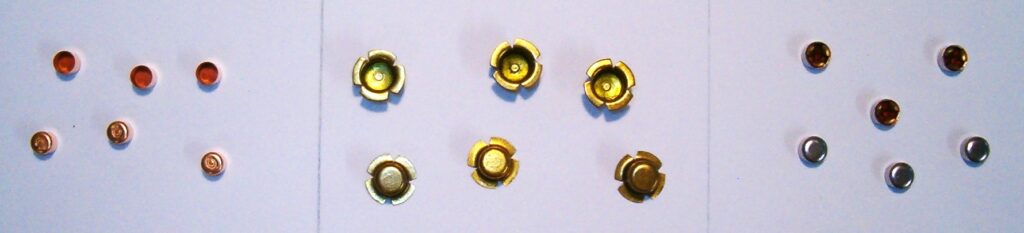
The goal of this series: the production of No. 11 percussion caps (left), musket caps (center) and large rifle primers (right)
INTRODUCTION
This is the first installment in a series which will develop a system for the manufacturing of primers. It will focus on number 11 percussion caps for muzzle loading arms, musket caps, and Boxer type large rifle primers. I will present a process which can consistently produce correctly sized primers of commercial quality and reliability.
Ammunition Comes And Goes
Like many shooters, I am aware of the fickle nature of our ammunition supply. Scarcity of ammunition is a problem that comes and goes, but no matter what happens it always recurs. Its causes are many. They include destructive intervention by politicians, heavy demands due to military use, and panic buying by the public.
The fortunes of ammunition companies must also have some influence on this situation. They struggle with with issues of raising capital, and have to produce the ammo most in demand. This last consideration may lead them to cut back on less profitable types of ammo.
The Solution To Scarcity
As a remedy for ammunition scarcity, I have always favored measures which guarantee self-sufficiency. One of the most reliable avenues of self-sufficiency in the matter of ammunition would seem to be reloading. However, reloading is not the panacea which some wish it to be. When manufacturers take profitable ammunition off the market, the components from which they produce it likely cannot be found. Reloading relies upon the recycling of spent casings and spent primer cups. There is a limit to how many times we can revive the remnants of used ammo.
The only enduring solution to the problem of scarcity is to develop systems for making components in small shops. This suggestion will seem fantastic to many. I am here to prove that it is not. With a little effort, we will create a system to manufacture primers on a small scale.
In the short term, I recommend that we all maintain a good supply of commercially made primers. I do not know what the future may hold for the availability of reloading components, but it is possible they could disappear. It is to our advantage to cultivate a community of craftspeople capable of establishing manufacturing processes for all ammunition components.
Why You Should Learn To Manufacture Primers
My reader may, with some justification, ask why one should take the trouble to learn to manufacture primers. The answer is that all who cherish the right to bear arms should learn to manufacture all components of ammunition. This means bullets, propellants, and casings as well as primers. I have made primers my starting point because I already have an audience interested in recycling spent commercial primers. This has given rise to the sale of products such as Prime All. There may be other vendors of expedient, impact-sensitive fillers for recharging spent primers. (You may refer to my prior article which evaluated the Prime All product (click here).
Key aspects of the process for manufacturing primers will be repeated in the systems we develop for other components. Having systems for making these components implies process control, the implementation of which is critical to any type of manufacturing. All of this becomes apparent if we clearly define what is meant by the term manufacturing primers.
What Do We Mean By The Term “Manufacturing Primers”?
As used in modern trade and business, the term manufacturing means more than simply making. In the case of tangible products, it means that the things we make are predictably alike. Their similarity arises from the fact that they all share those common properties that make them useful. Useful means, among other things, reliable. In the case of primers, this means that we manufacture them by identifying the qualities that distinguish a good primer. We then build these qualities into all our output. We work to conscientiously eliminate those properties which impede their intended function. To manufacture primers, we will set up a process which guarantees our output will meet the defined standards.
THE QUALITIES OF MANUFACTURED PRIMERS
There are certain properties which primers must possess if they are to function in a satisfactory way. At this point, I will list what I consider the most essential properties of high quality primers. This is by no means an exhaustive list, but I am confident it includes the essential features of a well made product.
We Make Primer Cups Of Material Which Can Withstand Ignition
Whether caps for muzzle loaders, or primers for cartridge ammunition, all primers restrain explosive force. Primer compositions ignite vigorously when struck with sufficient force. Therefore, they must be made of a material strong enough to contain the explosion caused by ignition. The cup must direct it into the breech of a muzzle loader or the cavity in a cartridge.
Primer Cups And Anvils Must Not React With The Explosive Filler
We must make primer cups and anvils of material that can endure contact with the explosive filler. Corrosion will be a problem if we neglect this issue. The body of the cup must be somewhat ductile, so it may expand over the nipple of a muzzle loader. In the case of a cartridge primer it must flow and seal in the gases generated by the propellant. It is clear that a certain degree of ductility is required for cartridge primers and those made for muzzle loaders.
Dimensions Of Primer Components Must Be Tightly Controlled
We must closely control the dimensions of primer cups. They have to fit the features of the components with which they mate. Muzzle loading caps must cling tightly to the nipples on which they are placed. Cartridge primers must fit the primer ports in the cartridges where they are installed. They should insert easily enough that they are not a nuisance to place. However, they must fit tightly enough to have good contact with the walls of the port. On firing, they must expand to securely seal the cartridge.
The Priming Compound Must Be Reliable And Durable
The priming formula we compound must be up to the task it is to perform. This means that it can produce reliable ignition of our propellants. It must remain stable in contact with the material of which the primer cups are made. It cannot deteriorate in contact with any of the other materials present in the cartridge. If we use a mixture of reagents to prepare our priming mixture, we must integrate them completely. We need a process which will result in complete incorporation. The instruction to “mix the ingredients until a uniform color is produced” is useless. It will yield utterly random results, completely unacceptable for manufacturing primers. A mechanical means of combining the ingredients is required, but we can only make this a less hazardous operation if we follow very specific guidelines.
Meaningful Tests Of Reliability Are Crucial
Once we are producing primers, the next challenge is to test them for reliability. At a minimum, this will demand that we devise an impact tester. This device should be adjustable, to apply a selected impact force to our test specimens. The force applied must be equal to that of the weakest acceptable firing pin impact. Recognized military and civilian standards tell us what this force should be.
We Design Our Process With Safety In Mind
It almost goes without saying that all of these objectives must be met through a process that is safe. We want to emerge from our work in one piece.
This is a general description of the targets we must hit if we aspire to manufacture primers. They define the technical challenges we must overcome if we are to devise a successful process. How can we fulfill all these requirements with the resources available to us? We will need sufficient technical information, sound materials, good tools, and most of all skill. This is the first part of a series which will elaborate on these topics. In later installments, I will explain in detail the processes I have worked out to achieve our desired outcome.
MANY READERS ALREADY KNOW A LOT ABOUT PRIMERS
I think it accurate to say that most shooters and reloaders are not beginning this quest with a blank slate. Reloaders, in particular, have acquired a store of knowledge of large rifle primers, acquired by a sense of touch. They can feel when a primer seats properly. That same tactile sense tells them when something is amiss. It could be a defect in their primers, or in the primer port in the cartridges they are using. They know if fired primers appear “normal” after firing. They can feel the ignition their primers initiate when they fire the cartridges they reloaded. This experiential knowledge is valuable. It can be used to test whether the process they adopt for manufacturing primers is giving us a seriously flawed product.
The daily experience of shooters and reloaders is valuable and not to be ignored. Indeed, their evaluation is the factor that makes or breaks commercial primer manufacturers. Shooters may not be able to set up a primer factory, but they know when the manufacturing process has gone wrong.
The users’ experience is crucial to setting up a system of manufacturing primers. However, it is not sufficient, in itself, to permit us to implement a consistent and sustainable system. We should aim for a product of consummate quality. We need access to knowledge hidden behind the walls of the factories which make quality primers.
UNDERSTANDING THIS SERIES: HELPFUL BOOKS
There are very few books that unambiguously reveal the processes implemented by respected ammunition companies. Fortunately, there are a few information resources which are very good indeed. Some of them are specific to the narrow topic of manufacturing primers. There are also more general works covering the topics of chemistry and metal forming technology. With these, we can supplement our manufacturing knowledge.
Books Revealing The Overall Process Of Primer Manufacture
I have located two books which address primer manufacturing in specific terms. The most recent is by George E. Frost, Ammunition Making (Washington D.C., NRA Publications, 1990). The second predates Frost’s work by seven decades, namely, a book by Douglas T. Hamilton, Cartridge Manufacture (New York, The Industrial Press, 1916). We review both of these works in our Bibliography. You may read that document free of charge by visiting our Free Resources page (click here).
A Book Containing Instruction On Primer Chemistry
I will mention three additional books at this point. They contain information which makes it easier to implement the procedures outlined in Ammunition Making and Cartridge Manufacture. The first work is by Tenney L. Davis, The Chemistry of Powder and Explosives (New York, John Wiley and Sons, 1941). It provides formulas and instructions for the preparation of priming compounds. It also appears in our Bibliography. Dr. Davis gives very little information on safety procedures in this book. At the same time, he has written it in the style of a cookbook. Therefore, I recommend that the reader not rely upon it for safety information.
Books Helpful To Understanding Diemaking
The second book in the trio is D. Eugene Ostergard’s Basic Diemaking, (New York, McGraw-Hill, 1963). You should read this in conjunction with a manual by Cyril Donaldson, et al., Tool Design, (New York, McGraw-Hill, 1973). I bring up these books because they explain the fabrication of punching and drawing tools. Those skills are essential to making primer cups and anvils.
WHAT COMES NEXT
In Part 2 of this series, I will outline the overall primer manufacturing process. I will identify the types of metalworking tools which we require to produce them in the small workshop. The process I shall describe is one I have drawn from the works that I listed in the two preceding paragraphs. However, I will not cross-reference every step of my system. If you must review the chapter and verse which supports each particular step, I would have to give you a most tedious essay. Therefore, if the reader has access to the works listed above, I would urge him to review them. Chapters 1 and 2 of Basic Diemaking are very helpful to understanding the process of punching out the blanks for primer cups. You will find that Chapter 10, parts 10-4 through 10-8 of Tool Design are especially relevant to the drawing processes I will introduce.