

By Joseph Reichert
- © 2025 Joseph Reichert, Inc.
- First Publication: February 4, 2020
- Revisions: May 1, 2025; January 17, 2026; June 14, 2026; June 26, 2026
NOTICE OF COPYRIGHT AND LIMITED LICENSE TO REPRODUCE AND DISTRIBUTE THIS DOCUMENT
Joseph Reichert, Inc., a New Mexico corporation, owns the copyright in this document, and is the only person lawfully allowed to publish it.
Joseph Reichert, Inc., makes a special exception to its exclusive rights in this work, and all persons are hereby granted a license to reproduce and distribute it, subject to the following conditions: (1) Under no circumstances shall any charge be exacted for any copy of this document, including charges for the costs of reproduction or distribution of the same; (2) any and all copies distributed pursuant to the terms of this limited license must be given in complete and unmodified form, including the full text of this Notice, which must be conspicuously displayed on the first page.
Any use of this document which varies from the terms of this license is a violation of the copyright owned by Joseph Reichert, Inc., and infringement will be vigorously pursued under the terms of the United States Copyright Act.
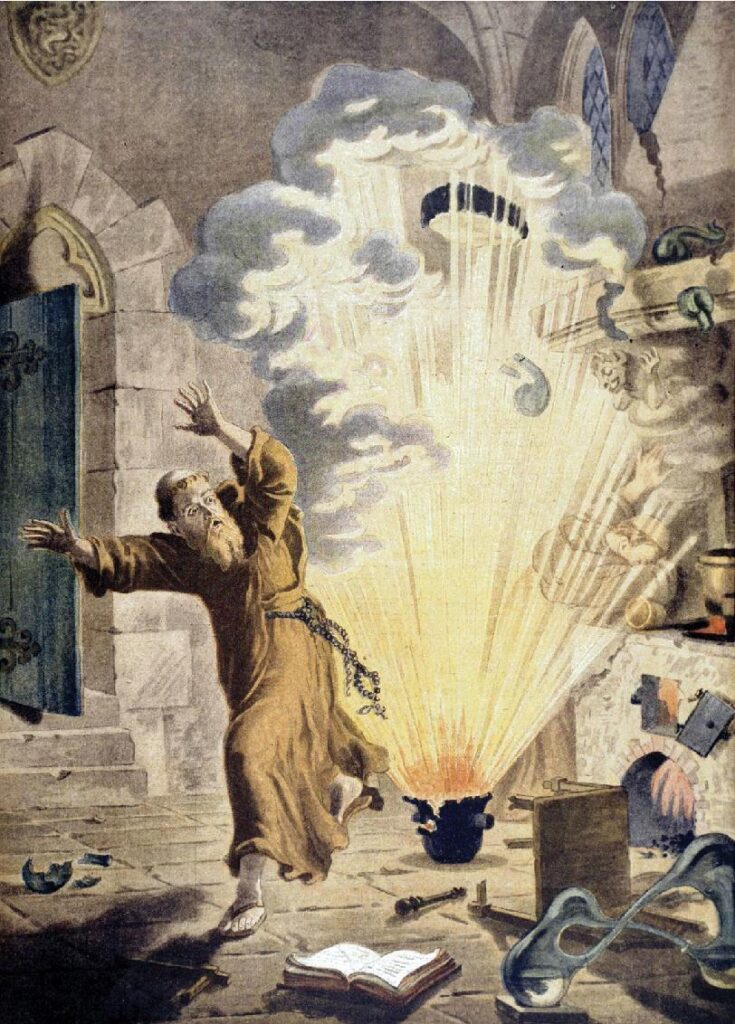
Berthold Schwarz, credited with the invention of gunpowder. Some claim that he discovered its properties by accident, while pursuing experiments in alchemy. Be creative, but do not follow his example. Always practice safety when making powder and primers!
INTRODUCTION
The primers and propellants used in small arms ammunition are useful because they have the capacity to rapidly generate large amounts of intensely hot gas when ignited. Therefore, the very property that makes them useful also renders them dangerous. This means that a person working with these materials must take precautions to avoid serious injury or death, always remembering one overriding truth: anyone who spends enough time near these materials will eventually see them ignite unexpectedly. When this happens, the worker’s life and health will depend entirely upon the safety measures he or she has put in place prior to starting operations.
This article attempts to identify some of the safety measures needed to prevent personal injury and damage to property. However, its suggestions will not guarantee complete safety when working with powder and primers. No easy prescription will cover all possible situations. Every person working with such materials must exercise prudent forethought before handling them. It is up to you to secure your own safety when making or using energetic materials.
THE CAUSES OF ACCIDENTS: AN INCOMPLETE LIST
As used in his context, the term “accident” means an unintended event which causes personal injury to people, damage to property, or both. Unexpected and unintended ignition is the primary cause of accidents when working with propellants and primers. While this appears to account for most documented events, a host of other factors can cause accidents. It would be presumptuous of me to claim that I know the origin of all mishaps, but extensive reading over a period of many years has made me aware of some of the risk factors. The following factors cause many avoidable accidents. Do not overlook these dangers when experimenting or making ammunition.
Some Materials Ignite Unexpectedly, Without Prompting.
Some propellants and primers are inherently unstable, and will ignite or explode without provocation. Certain mixtures have a tendency to self ignite, degrade, or cause other problems with little or no outside influence applied to them. Your safety when working with powder and primers will largely depend upon your ability to identify dangerous combinations.
Many of them become more sensitive with the passage of time. A good example is a priming mixture which combines a chlorate with sulfur. Mixtures of this type must be impact sensitive in order to work in primers, but they can also ignite spontaneously if improperly compounded. They become more dangerous as they age, unless we add an antacid to them to prevent “souring”. Souring occurs when the sulfur forms sulfuric acid. Atmospheric oxygen and humidity combine to produce sulfuric acid, (though some authorities regard this as unproven). Whatever the source of the danger, chlorate and sulfur mixtures have caused many injuries, and more than a few deaths.
Unpredictable Reaction Speeds Cause Accidents
Aside from the issue of spontaneous ignition, there is the problem of sensitive mixtures and compounds which produce varying and unpredictable responses when ignited. Certain pyrotechnic mixtures may burn in a flash in some instances, but detonate at other times, though the mass of material present be the same in both cases. “Flash powders”, made by mixing powdered metals with powerful oxidizers, are especially risky in this respect.
Flash powders are prone to “self-containment”. This means that they “burn so quickly that they cannot get out of their own way”. This phenomenon depends not only on the mass present, but how closely we confine it. Other factors also contribute to self-containment. Some authors on pyrotechnics state that ambient temperature and local humidity play a role .
Certain granular propellants can also produce dangerous pressures in small arms and artillery if they deteriorate. Proper functioning of granular propellants depends on their ability to maintain their structure. When propellant grains fracture, the additional surface area exposed by that fracture will cause them to burn faster. The evolution of gas accelerates to a create unsafe pressures, possibly rupturing the weapon and injuring the shooter.
We intend that flash powder and granular propellants burn vigorously, but they may prove capable excessively powerful responses. Under some circumstances, they will react in unexpected and destructive ways. If you wish to avoid this danger, you must know the causes of these phenomena. Awareness of risk is a foundation of safety when making powder and primers. The chemical combinations you produce may react with force far greater than you intended.
Some Mixtures Release Uncommon Forms Of Energy
Still release energy in an unexpected way. Conspicuous among these are pyrotechnic blends containing silicates, which in certain combinations will generate an intense blast of ultraviolet radiation when ignited. One eminent author in the field of pyrotechnics has written an article about his experience working with a silicate based mixture.
He took all the usual precautions to protect himself against blast, shrapnel, and burns generated by ordinary heat. His experimental mixture exploded unexpectedly, but the harm he suffered came from a cause he never contemplated. Instead of an ordinary burn, he suffered an exquisitely painful sunburn across his face. He used only goggles to protect his face. Fortunately, these had ultraviolet resistant lenses. He claims that without such lenses he would most certainly have been left blind. He learned a painful lesson: silicate based mixtures can generate intense UV radiation.
If you compound propellants and filler material for primers, you must know how to be safe when working with these products. A full understanding of their behavior, when ignited, is absolutely necessary if you want to be safe when working with energetic materials.
Foreign Substances Can Cause Accidents
Foreign substances can creep unnoticed into primer material or propellant, which changes their behavior by effectively modifying their composition. The primer or propellant can become sensitized and prone to spontaneous ignition through the presence of such adulterants. We have a persistent example of this sort of mishap. In commercial powder mills, small pieces of ferrous metal or hard rock can fall into the raw ingredients of black powder. These contaminants travel into the mill with the potassium nitrate, charcoal and sulfur. If the manufacturer does not remove this foreign matter, unexpected ignition can take place, because metal and rock produce sparks and friction. Similarly, the accidental introduction of even small quantities of chlorates into black powder will render it prone to spontaneous ignition.
External Forces Can Cause Accidents
Closely related to these dangers is the unintended application of external forces to these substances. Such forces can take the form of heat, static electricity, impact or friction. I do not intend this list to be exhaustive. It only covers the most commonly documented energy sources responsible for accidents. You must assume that any and all priming materials and propellants are responsive, to some degree, to all of the forces I mention.
You can provoke an accident by the imprudent application of forces and energy to the less dangerous classes of propellants and primers. A good example is the practice of mixing black powder in a ball mill using sparking grinding media, such as steel balls, rather than non-sparking balls made of brass or lead. Similarly, some have neglected to use sufficient grounding to keep their mills free of static electricity, or have failed to ground themselves when making contact with an otherwise properly grounded mill, thereby generating sparks which set the powder off.
Improve your safety when making powder and primers. Take your whole process into account, and diligently removing anything that might generate friction, sparks or electrical discharges.
A FEW PRUDENT SAFETY MEASURES
The foregoing list presents frequent causes of accidents. But what can we do to reduce the risk of personal injury and property damage when we compound propellants and primer materials? Bear in mind that one can only reduce risk, but not eliminate it. We cannot eliminate all hazards. When you manipulate these materials, you are to some degree endangered. Do not make a distinction between dangerous and safe, but between dangerous and less dangerous. The following precautions must be in place at all times, and for all materials.
Do Not Cross-Contaminate your Primary Materials
Adulteration of chemical components is probably the most common safety infraction I have witnessed. Once you have inadvertently allowed contaminants to enter a container of a chemical which you believe to be pure, you may have laid a trap for yourself. That trap will lie in wait for you as long as the contaminated chemical sits on your shelf. To be safe when working with energetic materials, you must exercise vigilance to avoid cross contamination.
I have frequently watched enthusiastic experimenters using one single scoop to withdraw reagents from their containers, while neglecting to clean the scoop between steps. An experimenter uses a scoop to withdraw potassium chlorate from a storage jar and places it on a mixing surface. Shortly thereafter the same operator will plunge that scoop into a container of antimony sulfide, neglecting to clean it of chlorate. This is the height of dangerous laziness. He has contaminated the antimony sulfide with a chlorate. This impure reagent can now find its way into all sorts of other mixtures. It can now contact mixtures which are made sensitive by the presence of chlorates.
When you prepare any chemical mixture, each reagent you use must have its own measuring scoop. Never allow a scoop to make contact with any other chemical. When you combine chemicals, you must use a dedicated tool for the stirring process. To mix reagents, I strongly suggest that you use disposable measuring and stirring implements. Discard mixing tools after one use, after thoroughly rinsing them with a strong stream of water.
If you recycle your measuring tools, you absolutely must cleanse them thoroughly after each use, and insure they are thoroughly dry before using them in future operations.
You Must Completely Avoid Certain Materials. They Are Entirely Too Dangerous.
Sometimes, it is impossible to be safe when working with energetic materials. There are certain materials which are ultra hazardous under all circumstances.
You must avoid some materials altogether, if you tender your life. Among these, I place all fulminates, nitroglycerine, trinitrotoluene, most flash powders, and any except the most very small quantities of chlorate and sulfur mixtures. In a commercial setting, workers have the equipment to manipulate these substances remotely through mechanized tooling and processors. These compounds explode from time to time. When they do, they destroy the processing machinery. These explosions cause significant property damage. Fortunately, the workers seldom suffer injury.
Know The Materials You Use. Avoid Unknown And Insufficiently Documented Materials
Even in the case of well known mixtures and materials, I recommend that you test their sensitivity to determine what types of handling they can withstand. With experimental batches of newly designed propellants and primers, such testing is absolutely mandatory. Thereafter, avoid influences which you find will set them off. Put them to their appropriate uses while eliminating actions which provoke them.
You can test unfamiliar substances for sensitivity to impact by dropping a weight upon a test sample from increasingly greater heights. You can test for sensitivity to friction by rubbing a sample between two hard, coarse surfaces in a deliberate attempt to induce ignition. Placing a sample upon a metal plate and very slowly raising the temperature of the plate is one way to test how sensitive it is to changes in temperature, and to determine its ignition point. Test a sample with electrical discharges, to determine if current or electrical sparks will ignite it. You should perform all these tests with the operator at a safe distance from your sample.
Some Materials Become More Sensitive With Age
You may take the greatest pains to follow safe practice when compounding a mixture, but this may not be enough. Safety when making powder and primers may well depend upon how your product ages.
Many tests are useful for learning the characteristics of a material in its present state. It is much more challenging, however, to determine if it will remain stable over time. Certain propellants and primers can become exquisitely sensitive over a period of years and even decades. Others slowly react with materials in their environment to produce dangerous conditions. These undesirable tendencies reveal themselves through disasters, caused by materials once thought to be perfectly safe.
Examples Of Instability Caused By Age
Several famous examples of degradation over time come to mind. The “season cracking” of brass cartridge cases caused by mercuric primers is a notable example. Similarly, grains of ammonpulver tend to fracture after exposure to the levels of heat encountered in desert climates. Cases cracked by mercuric primers can open up on firing and damage both the gun and the shooter. Fractured grains of ammonpulver burn at a much faster rate than intact grains. This increases the chances of excessive pressure in a chamber.
Another good example of a material that becomes unstable over time is dynamite. As originally compounded by its inventor, Alfred Nobel, it could deteriorate. Nobel liked to show off the safety of his new explosive. He heated it and subjected it to impact. He did this to prove that it can only be set off by a cap filled with a primary explosive. At the time was that, in long term storage, the nitroglycerine contained in dynamite can leach out. Once free of suspension in clay, it will form fibers. This is one of the most unstable explosives known. It took several spectacular accidents for Nobel and his customers to recognize this danger.
Never Trust Any Material To Behave As You Think It Should
The passage of time is essential to producing the dangerous decay of these materials. Only the passage of time can reveal their most menacing defects. The only test which could reveal their perils would be to store them and transport them about for many years. This burdensome experiment would have to be conducted in various environments. I have never found any studies to indicate how “age test” procedures can be accelerated.
Never trust any primer or propellant to behave as you think it ought. They are only useful because they are, to a greater or lesser extent, unstable. Were they not dangerous, they would be useless.
Do not rely upon the peaceable character of the individual ingredients in a mixture. They may well be uncontrollable when combined. Consider the example of the nineteenth century novelty known as “fulminating powder”. It is a mixture of nothing more than potassium nitrate, potassium carbonate and sulfur. If we examine these ingredients separately, they seem innocuous. We would not expect that a combination of them could produce more than a rather weak propellant. When we heat them slowly, to the point of fusion, it is a different matter. This mixture will first melt, then bubble and turn brown, and finally detonate fiercely. This detonation can deform or puncture a steel plate on which the powder is heated.
The Risks Of Manufacturing Energetic Materials Are Often Greater Than The Risks Of Using Them.
Maximum prudence dictates that you work only with substances of known, stable composition, with well researched and thoroughly documented characteristics. Before handling them, you must be completely familiar with said research and the relevant documents. In many sources, authors list these as “traditional” primers and propellants. This category includes black powder, smokeless propellants, and some commercially available primer compounds. To achieve maximum safety when you prepare powder and primers, make sure to mix them in them in small quantities. Manufacturing these things is always far more dangerous than using them as a consumer.
The category of “traditional” materials also includes those you have fabricated yourself, if you follow well known formulas and processes. However, you must clearly understand that the fabrication processes entails risks distinct from the risks attached to using them. For example: accidents with finished black powder are few, but history shows that powder mills have exploded with alarming frequency. Leading companies such as DuPont designed mills with detachable roofing and collapsible walls. These features dissipate the force of unexpected explosions. The risks of manufacturing primers and propellants are distinct from, and usually greater than, the risks of using them.
Work Only With Small Amounts Of Material
What is small is relative to the power and the proclivities of the substances you choose to handle. For example, pyrotechnic textbooks recommend that we work with have no more than one pound of black powder. This is the maximum that should be in our work area at any given time. These texts also advise that we do all our work completely away from powder storage facilities and magazines.
However, a fraction of a gram is too much if you suspect that a material may be susceptible to detonation. How much of any given primer or propellant you choose to handle is a matter of good judgment. Your life and health depend upon nothing so much as the exercise of good judgment and situational awareness. (Be cautious. The law and industry standards may allow one to store far more propellant than most deem safe.)
It is unfortunate, but safety when working with powder and primers is not an exact science. It is often a matter of judgment. How much is too much depends upon what specific substance you are handling. An experimental firing of you material should inform you of how much you should allow in one place.
Protect Yourself From The Risk Of Burns
Propellants, such as black powder, black powder substitutes, and smokeless powders, produce self-sustained burning. They instantly generate large volumes of intensely hot gas. If they cannot produce such a reaction, they cannot do the work of driving a projectile. Indeed, physicists characterize the gun as a type of “heat engine”. Heat engines do their work by harnessing high pressure combustion. This category includes guns, rockets, automobile engines and jet propulsion systems.
Finely divided black powder burns with a sudden flash. We often call this deflagration, a reaction far faster than ordinary burning, but slower than detonation. Some propellants straddle the line between deflagration and detonation. Flash powders behave this way. They are compounded out of finely divided metal fuel and a powerful oxidizing agent. Well informed experimenters rightly fear these compositions because they have a propensity for “self containment”. That is, they generate hot gas at such an astonishing rate that their deflagration can become a detonation. Their exceedingly fast reaction rates makes them unsuitable for use as propellants in guns.
Use Proper Protective Clothing To Reduce The Risk Of Burns
When ignited in confinement, propellants can burst through the container constraining them, and envelope surrounding objects in a fireball. Black powder produces a cloud of incandescent gas at a temperature in excess of 1400° C, more than sufficient to inflict massive third degree burns on the heedless handler, and sufficient to ignite anything combustible in proximity to it. Distressingly, the clothes of a person burned by a large quantity of black powder are frequently set aflame. However, if made of synthetic material, the victim’s garments often melt to his body. Heat stays on the surface of the skin, and his burns become more severe than they otherwise would be. At the very least, any and all primers and propellants can inflict severe burns. Those who manipulate materials of this sort find that burns are the most common form of injury.
A minimal regard for your own well being demands that you at least wear an OSHA approved, full-face mask, a pair of UV blocking OSHA approved safety glasses, a high quality leather welder’s apron, heavy duty welder’s gloves, fireproof leggings, and commercial grade welder’s sleeves whenever you approach these materials. Beneath all of this personal protective equipment you should wear several layers of all-cotton clothing. You must cover your head, including your ears, with a heavy cotton bandanna. Scrupulously avoid all synthetic clothing, which can melt onto your skin.
Have copious amounts of water available, to douse yourself if things go awry. An even better measure would be to construct an overhead tank in your workplace, with a pull chain that will allow you to douse yourself with its contents all at once. Work in close proximity to this appliance. Do not neglect to test its function from time to time. Assure yourself that it works.
In Addition To Personal Protective Equipment, Use Physical Barriers To Shield Yourself
In addition to your personal protective equipment, that is, the protective clothing and shields that you wear, you should also insure that you have physical barriers in place to separate you from the substances with which you work. You can build portable walls and custom enclosures on an as-needed basis.
Materials such as plywood can protect you from a fireball, but you should prefer barriers made from materials highly resistant to flame. Sheet metal and cement board are useful fireproof barriers, reasonably light in weight, and generally affordable. Attach them to lightweight tubular metal stands to give them rigidity and portability.
You must position your safety barriers in such a way that any unintended ignition flows away from you. I advocate that you conduct your operations outdoors. You are safest when your layout channel a propellant fireball straight up. You will find this easiest to do in an outdoor setting. Hot gases have a natural tendency to rise in any event, and you can use this physical fact as a safety feature. In most situations, the worst direction to channel an ignition is horizontally, where it can contact other persons or flammable materials in your environment.
It goes without saying that any operations carried out on energetic materials are probably best conducted outdoors, unless you have the luxury of a specially constructed facility for your operations. This consideration leads to the next point, that you must be totally alert to your surroundings when working with primers and propellants.
Be Completely Aware Of Your Surroundings. Avoid Any Situation In Which Physical Obstructions Can Channel A Blast Back At You.
The worst possible scenario would be the case of ignition of a large mass of propellant, with no safety barrier between the powder and the worker, the worker lacking any protective clothing, and the accident occurring in a closely confined space filled with large amounts of other combustible substances.
To focus on the latter part of this statement, for purposes of safe practices with primers and propellants a “closely confined space” may not always be apparent to the inexperienced observer. If you work with a propellant like black powder on an open table which is pushed up against a wall, the wall may very well well push a fireball back in your direction. Do not work in a location where your physical surroundings are so composed that they can channel a cloud of incandescent gas or the force of an explosion in your direction.
Determine The Path An Accidental Blast Will Follow
The case of Bushnell Smith, a famous gunsmith of the early twentieth century, presents the most egregious example of lethal channeling of the byproducts of an explosion. Smith worked in a room which had a window looking out into a rural field, where he had targets set up. He would try out weapons he had repaired and modified by firing them at the targets through his shop window, checking his scores with a spotting scope. At the back of his workshop was a room, more in the nature of a closet, in which he stored large quantities of reloading powders. This storeroom communicated with the shop by means of a narrow doorway.
One day, when preparing to a fire a rifle out the window at his targets, Smith accidentally discharged the weapon into the powder storage room. A subsequent investigation by law enforcement determined that all the powder ignited at once, producing a blowtorch flame which emerged instantly through the doorway and incinerated Smith.
Take heed of the path a fireball will take in the event you have an accident.
An Uncommon But Necessary Safety Measure: Test To Destruction
The prudent handler of primers and propellants must frequently stop in the midst of his operations and ask the following question: What would the consequences be for me if this material were to ignite now, without any warning? If he concludes that he would suffer injury, he has failed to implement proper safety measures. He should stop all operations immediately, and not resume them until he has implemented reliable protective measures. What will happen to you if you have an unexpected ignition? There is only one way to know the answer to this question with reasonable certainty, and that is to test samples of your materials and equipment to destruction.
Assume that it is your practice to produce black powder one pound at a time, in a ball mill filled with non-sparking brass grinding media , using a heavy plastic container turned by rubber rollers. Whenever you load your mill, or approach it to check on the progress of the powder, you are properly clad in all the personal protective equipment previously described, and the mill is located outdoors and surrounded by what you believe to be adequate barriers.
Setting Up A Destructive Test
The best information you can acquire concerning your safety in the event of an accidental ignition while you are in close proximity to the apparatus, can be gathered by dressing a mannequin in the protective clothing you customarily use, placing the dummy close to the mill at the distance you usually occupy, and setting off a pound of black powder in the mill jar by means of a remote ignition switch. This experiment must be conducted in a remote area, far from any buildings and far from flammable material. The center of a large field, freshly plowed, would be ideal for such a study, as would an area of remote desert.
If you place stadia rods in the background directly behind the mill, you can take a video of the explosion and use the rods to visualize how large a fireball is generated. The condition of the mannequin should provide you with some concrete idea of what injuries you will suffer in the event of an accident. Track the location of the mill jar and any displaced parts of the mill assembly. How far has the debris traveled? Do the results lead you to believe that you have taken adequate measures to protect yourself from an accidental ignition?
Experiments of this type are indispensable, because one thing is certain: If you work with primers and propellants long enough, you will eventually experience an accidental ignition. How you fare will depend entirely upon the protections you have put in place before the event occurs.
CONCLUSION
The foregoing is the briefest summary of the measures you must take to protect yourself from injury. It is not a complete list of all risks you face when you work with primers and propellants, because the number of possible mechanisms of accident is infinite. Therefore, I urge all those who perform the type of work described on this website to study the subject of safety ceaselessly, and learn as much as possible about the properties of primers and propellants with a view to avoiding mishaps. In particular, thoroughly research each and every material with which you work, to learn of any risks peculiar to it. Test the processes which you intend to apply to that material; test them to destruction. These measures will reduce the peril in which you place yourself when you conduct your experiments.